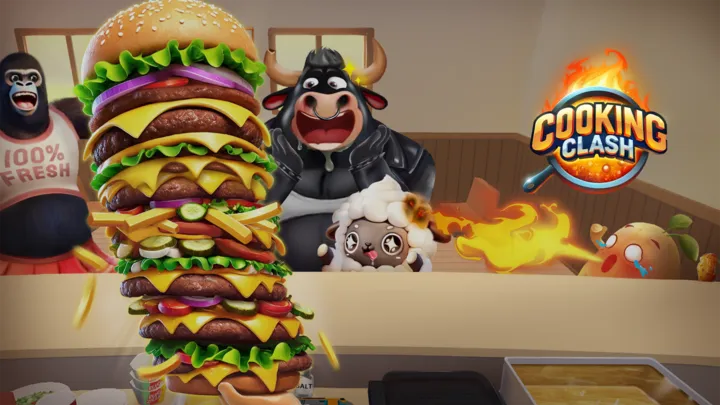

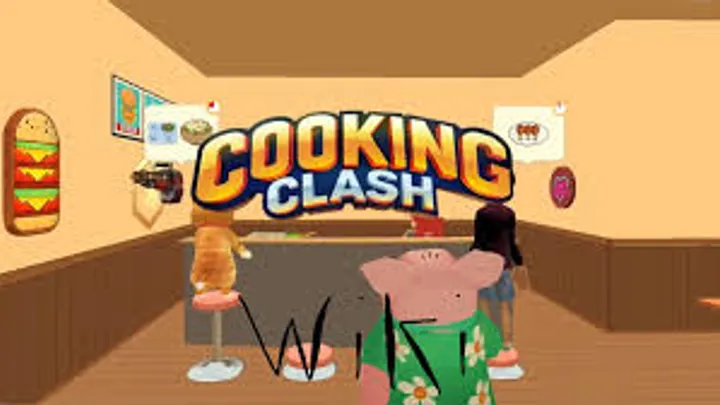





The rise of Cooking Clash as a mobile sensation was predicated on its promises of high-stakes, real-time culinary duels. However, as the competitive scene matured, a glaring technical flaw emerged that threatened the game's integrity: the Phantom Input phenomenon. This issue, rooted in the complex interplay between client-side prediction and server-side validation, creates a scenario where a player’s actions—chopping, plating, or seasoning—are visually confirmed on their screen but "rejected" by the server. In a game where success is measured in milliseconds, this desynchronization isn't just a bug; it is a fundamental breakdown of the player-game contract, leading to lost streaks and underserved defeats in the global rankings.
The Genesis of Data Synchronization Systems
In its early launch days, Cooking Clash utilized a simple synchronization mechanism known as "Lock-step." Under this system, every player action had to be confirmed by the server before being displayed on the screen. While this ensured absolute fairness, it caused extreme input lag, making character movement feel heavy and unresponsive. Players felt as though they were cooking underwater, where every tap took half a second to register.
To save the user experience, the development team transitioned to a "Client-side Prediction" system. This allowed the game to execute actions immediately on the player's device, subsequently sending the data to the server for verification. This shift inadvertently created the loophole for the Phantom Input issue, where the screen shows a completed action, but the server records the player as standing idle.
The Rise of the Phantom Input Crisis
As the player community entered professional tournaments in 2024, the Phantom Input error became a genuine nightmare. A Diamond-ranked player can perform over 150 Actions Per Minute (APM). When the speed of operation exceeds the network's packet processing capacity, actions begin to stack incorrectly. You might see your chef carrying a dish to the customer, only for that dish to suddenly vanish and reappear on the stove, burnt to a crisp.
This issue is not merely due to weak internet connections. Even with 5G or Fiber Optic, discrepancies occur because the game's interpolation algorithm tries to "guess" the chef's position. This results in "ghost" ingredients hovering in mid-air or skill buttons being disabled despite repeated taps. This creates immense psychological frustration, eroding trust in the transparency of the 1v1 duel system.
Technical Analysis of Packet Conflicts
The processing engine of Cooking Clash relies on frames. If the server runs at a 30-tick rate while a player's phone runs at 120Hz, a data gap is inevitable.
- Packet Loss: Critical commands like "Serve Dish" get lost in transit.
- Jitter: Cooking commands reach the server at irregular intervals, causing stuttering.
Impact of Latency on Combo Point Success
In Cooking Clash, scoring depends not just on completing dishes but on the Combo Point system. Every dish served successfully within the "Golden Window" multiplies the score. Phantom Inputs directly destroy this system. A single "missed" ingredient pickup due to slow server updates resets the entire combo streak to zero, costing players thousands of potential points in a single second.
The unfairness is compounded by the fact that the game's lag compensation does not operate uniformly across devices. Users with high-end flagship phones and superior network signal processors often hold an advantage over mid-range users, even if both possess equal skill. This transforms a game of manual dexterity into a race of hardware and infrastructure, stripping away the core eSport essence of the title.
The Crisis of Trust in the Competitive Community
The problem peaked during the "Clash Masters 2025" tournament, where the final match was interrupted because a contestant's shrimp soup vanished just before reaching the table. This event ignited a firestorm on forums like Reddit and Discord. Players demanded a permanent solution rather than apology letters or compensation packages consisting of a few virtual diamonds.
Community members began deep-diving into the source code and discovered that the game prioritized visual smoothness over data accuracy. Essentially, the developers preferred the player to feel like they were playing fast rather than having the screen freeze, even at the cost of data desync. This revelation disappointed many "pros," leading to a mass exodus and a significant void in the game's competitive ecosystem.
Forced Adaptation Strategies of Professional Players
To survive in this unstable environment, professional gamers had to innovate "counter-mechanics" for server instability. One such technique is Double-Tapping. Instead of tapping once to grab an ingredient, players developed the habit of tapping two or three times rapidly to ensure the server receives at least one valid data packet.
Manual Optimization Methods
- Dedicated VPN Usage: To stabilize the data routing to the central server hub.
- Capping at 60 FPS: Reducing the volume of outgoing data to avoid clogging the server bandwidth.
- Static Positioning: Minimizing unnecessary character movement to prevent position desync.
Developer Response and Technical Patches
Under immense pressure, the publisher released the "Net-Code Overhaul" update. This patch introduced "Rollback Networking"—a technology typically reserved for high-end fighting games like Street Fighter. With Rollback, when a discrepancy occurs between the player and the server, the game automatically "rewinds" time by a few milliseconds to correct the error without interrupting the match flow.
However, implementing Rollback in a game with numerous entities (ingredients, stoves, customers, effects) was an extreme technical challenge. In the initial weeks, "glitch-stacking" occurred, causing chefs to clip through walls or transform into chaotic graphic clusters. It took nearly six months of fine-tuning for the system to stabilize and reduce the Phantom Input rate to an acceptable level for the majority of users.
Meta-Game Shifts Following the Overhaul
Once Phantom Inputs were controlled, the meta-game of Cooking Clash changed entirely. Previously, players prioritized simple dishes to avoid network risks; now, complex recipes like "Seafood Platters" or "Grand BBQ Feasts" have taken center stage. Multitasking ability has truly returned as the primary metric for a chef's skill, rather than the ability to "tolerate" network errors.
This stability also brought back tournament sponsors. Matches are now more visually appealing as actions occur smoothly and accurately frame-by-frame. Spectators no longer have to witness illogical losses, and players can confidently showcase high-level techniques like "Quick-swapping" or "Perfect-timing" for baking without fear of server rejection.
The Future of Data Processing in Gaming
Despite improvements, the lesson from Cooking Clash highlights the limits of current mobile technology in handling high-intensity real-time games. Experts predict that the future of titles like Cooking Clash will involve integrating AI to predict player behavior more intelligently than basic interpolation. AI could learn individual cooking habits to fill data gaps naturally.
Furthermore, Edge Computing is a potential direction. Instead of all data traveling to a central server thousands of miles away, data would be processed at stations nearest to the player. This would effectively eliminate the concept of Phantom Inputs and provide a perfectly fair competitive environment for every gamer worldwide, regardless of their geographic location.
Rebuilding a Sustainable Community Culture
Following the technical storm, Cooking Clash is striving to rebuild its image by making technical stats transparent within the game menu. Players can now see live indicators for Ping, Packet Loss, and Jitter during matches. This helps them decide when to play aggressively and when to play cautiously to preserve their score. This transparency has calmed the community and created a more technically literate player base.
Additionally, the developers launched monthly "Dev Talks" to listen to feedback regarding "gameplay feel." They realized a successful game needs more than just pretty graphics; it needs the stability of the most basic experiences. Maintaining a solid connection between the player, the device, and the server is the key to Cooking Clash holding its ground against a sea of new competitors.
The Journey Through Technical Failure
The journey to resolve the Phantom Input error in Cooking Clash is a testament to how mobile gaming has reached the threshold of rigorous eSport standards. From the lag-filled early days to the adoption of advanced Rollback technology, the game has undergone a structural transformation. While scars from the past remain, the efforts to improve have made this game not just a tool for entertainment but a symbol of persistence in software development.
Conclusion: The issue of data synchronization in Cooking Clash has taught both developers and players the importance of precision in the virtual world. When a small action like sprinkling salt can determine a champion, technical stability is the firmest foundation for success. Today, Cooking Clash is not just a battle between chefs, but a battle of technology to bring fairness and peak emotion to the players.